
The Virtual Office — A key component of the future of AI and human collaboration
12 September 2025 · Peter Lee
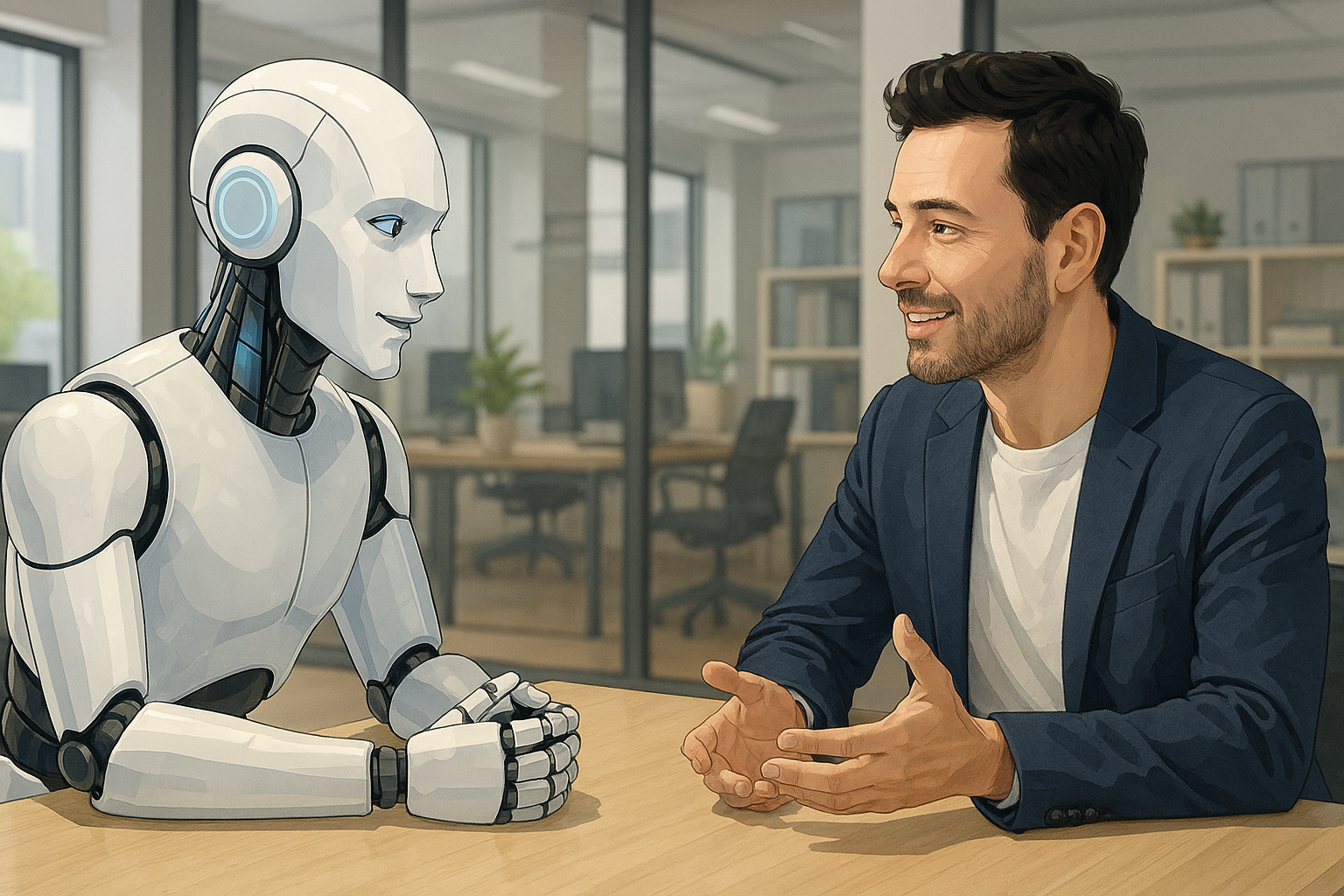
I think by now it's obvious that your next teammate might not be human.
As we move toward the world of agentic companies, organisations where AI agents act as true teammates that can work independently, it's worth asking: where will we actually interact with them?
For some types of work, messaging an AI agent works perfectly.
Coding, basic queries, structured tasks.
But recently I had an experience that made me rethink what the future of work and the future of virtual offices would actually look like.
A Chuck Norris Moment with AI
Driving home from my son's soccer practice recent, he asked me, "Who's Chuck Norris?"
I explained that he was a martial artist and actor, and that when I was a kid, a whole subculture of jokes had sprung up about his legendary toughness.
The problem? I couldn't remember a single Chuck Norris joke on the spot.
So I switched ChatGPT into voice mode and within minutes, the three of us — ChatGPT, my son, and I — were laughing our way through chuck norris jokes. Sometimes we asked the AI for one more, or sometimes ten. What was interesting, was how natural experience felt.
Sure, it wasn't perfect. It occasionally stopped mid-sentence, tripped up by background noise. But when it worked, the interaction felt conversational, engaging, almost human. The AI used little chuckles and emotes to make the conversation feel even more natural, creating the social lubricant that had both my son laughing away uncontrollably.
And that when it struck me:
That atmosphere doesn't happen in chat. You can't "hear" emotions via chat, even if they are just AI-generated emotions. However when you were naturally conversing with the AI via talking to it, the entire dynamics of the conversation changed.
That's when it hit me: the natural meeting ground for humans and AI teammates isn't going to be chat. It's going to be voice.
From Chat to Presence
Text-based chat will always have a place, especially for technical teams doing things like coding, or querying certain topics. But when it comes to innovation, collaboration, strategising, and planning - the real driver of outcomes is the ability to create culture and connection. In these scenarios - voice conversations feel more natural and human.
This puts those companies focused on returning to the physical office at a clear disadvantage.
You can't bump into an AI agent in a physical office. They don't have bodies to be "present" at desks or in hallways.
But in the virtual office?
Well that's another story.
Imagine Jane, the AI Strategy Specialist, sitting in the Strategy Room, ready to brief you on emerging market trends.
Or Bob, the AI Operations Analyst, joining a Quarterly Business Review to bring real-time insights about performance.
Even Sarah the Engineering Manager who you could visit, talk about the next product build during the day, so that during the night she could co-ordinate a group of agent to do the next increment of the product build.
These aren't far fetched hypotheticals.
Companies like ElevenLabs (founded by ex–DeepMind engineers) are already pushing conversational AI forward at an incredible pace. Open-source projects like joinly.ai are experimenting with giving AI agents voices and the ability to participate directly in meetings.
Soon, talking with an AI won't feel novel and weird.
It will feel normal.
The Leadership Challenge
This raises an important question for leaders:
How do we design digital workplaces where humans and AI can interact and collaborate naturally?
Presence has always been at the heart of leadership. In a physical office, presence is automatic. Open doors, hallway chats, body language.
In virtual offices, presence must be designed. And when AI enters our workplace as a true teammate, this design challenge will only grow.
Leaders will need to think about:
- How can humans and AI "sit" together in digital workspaces
- What will be the most natural way for AIs and humans to interact
- How can we preserve trust, humour, and empathy across both humans and AI
Preparing for the Future
I believe that organisations that embrace virtual offices today will be setting themselves up for this future.
These environments will be where humans and AI teammates will co-exist, collaborate, and create amazing outcomes.
The future of virtual offices is what we explore in The Remote Work Formula — and the one we are helping to build at Berst.
Because the workplace of tomorrow won't just be hybrid between home and office. It will be hybrid between human and AI.
Read more in The Remote Work Formula
Learn how Berst is shaping virtual offices for the future: www.berst.io