
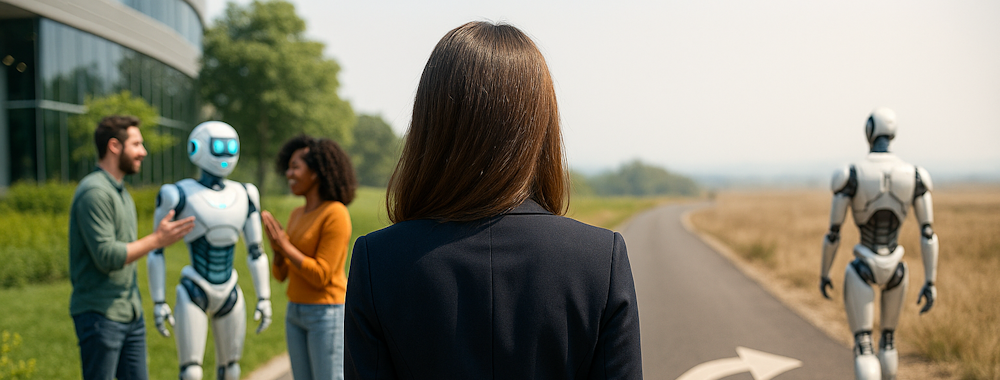
The rise of AI is generating a fascinating dichotomy about the future of work and a crossroads for leadership where leaders may move in one of two ways.
A less collaborative future where AI rules, or one that embrace the very fundamentals of human nature increasing collaborating and improving the very fabric of the societies we live in.
On one hand, AI seems to reduce the need for human collaboration. I've alarmingly heard leaders say: "Let's get AI to generate all the requirements and plan, so we can just focus on the work", or even Engineering leaders that say to their product teammates: "I just need you to write better requirements documents about exactly what we need, so that the AI can build the code automatically all the time".
But this mindset throws decades of research about transformational leadership and approaches like intent-based leadership out the window.
The Perfect Plan is a Fallacy
Dwight D. Eisenhower famously said
"Plans are worthless, but planning is indispensable"
The act of planning is about building alignment around multiple perspectives and views, not about the plan itself.
AI often presents the highest-probability answer as if it is the one right answer. The one right plan.
But humans, on the other hand, naturally challenge ideas, explore alternatives views, and bring their diverse perspectives to the table.
The way AI frames information risks driving teams down seemingly "likely" paths, even if they may turn out to be fundamentally wrong.
Intent-based leadership shows us something important about human nature. Humans interpret any piece of information differently. The act of planning is a collaborative exercise of building alignment between different parties.
The fallacy of the "perfect plan" doesn't disappear with AI - in fact, AI exacerbates it. AI-generated plans create the illusion of clarity, but hide the human divergence in interpretation. The danger of AI-generated "perfect plans" isn't only that teams may fail to challenge them. It's the false sense of alignment it creates.
Collaboration Matters Even More
In times of hyper-change like today, we don't need less collaboration - we need more.
The danger is falling into the trap of outsourcing to AI the very activities that are innately human:
- The conversations and debates that create innovative ideas
- The back-and-forth dialogue that surfaces alternate views and world perspectives
- The messy, iterative process of discovering what people really want from building and testing new ideas
Humans often don't know what they want until they see it. That's why the iterative process and prototypes matter so much.
The rise of AI actually creates newer more effective ways for humans to explore new ideas. AI can, and should, generate multiple possibilities of every idea we create. While we sleep AI can create 10 versions of an idea, that we have discussed and planned.
But those 10 versions aren't the end of the story. They're just the beginning. It's the human review, debate and refinement that will help evolve these possibilities into the real ideas that will drive real progress.
A Crossroads of Leadership
Modern leadership is at a precipice. We stand at an important crossroads:
- One path leads to a more siloed, less collaborative world, where humans hand over decisions to AI and lose the richness of social interactions.
- The other path leans into over 100 years of leadership research, reminding us that leadership is a social dynamic. It is human, it is collaborative, and it cannot be replaced by algorithms.
This doesn't mean we should ignore AI.
Quite the opposite.
AI is essential. It helps us remove the grunt work - the leg work that slows humans down.
Market research? We shouldn't be wasting hours googling. Let AI surface real-time insights from across the web.
Product reviews? Don't waste time clicking between screens pulling data about your product. Use AI to highlight and map the state of your product and highlight new technologies that could help you improve.
But what must remain human, is the interpretation, discussion, and debate that drives true accountability, creativity and exploration of what the future can hold.
The Future: Human + AI Collaboration in Virtual Offices
So how do we design a future where humans and AIs collaborate seamlessly?
At Berst, we believe the answer lies in virtual offices - spaces purpose-built for collaboration. Ones where humans and AI can co-exist in real time.
Imagine:
- Humans and AI teammates debating strategies side by side
- Leaders drawing on AI insights instantly while preserving human dialogue
- AI "minions" dispatched to mine the web for fresh data, while people focus on context, creativity, and decision-making
These offices won't replace human collaboration. They'll supercharge it - combining the best of humanity with the speed and scale of AI.
Final Thought
AI doesn't eliminate the need for leadership. It makes leadership more important.
Leadership is not about generating the perfect plan. It's about creating the conditions for humans to collaborate, challenge, and evolve ideas - now with AI as a partner.
The organisations that embrace this shift and design digital spaces where humans and AI collaborate naturally will be the ones that thrive.
This is the leadership precipice — the decision point between two futures.
Learn more about designing your Virtual Office for the future in our free ebook The Remote Work Formula.