
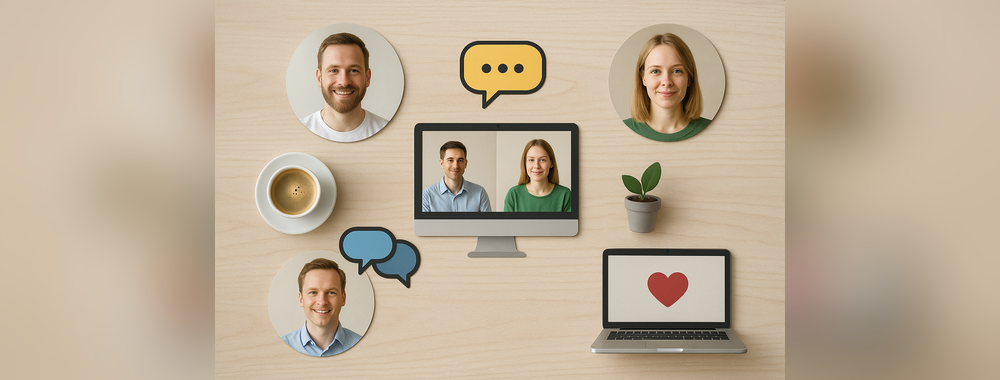
Culture doesn't grow by accident. Neither does connection. In physical offices, they emerge from architecture, rhythm, and proximity—none of which translate automatically into remote environments.
So, if you're serious about making remote work work, you have to design for connection. Not wish for it. Not assume it, but design it.
There are three pillars—often overlooked and rarely engineered—that determine whether a virtual office builds culture or bleeds it:
1. Micro Conversations: The Invisible Glue
The magic of an office isn't in the meeting itself. It's in the margins around meetings. The quick joke walking into a room. The glance that says, "Did you catch that?" The pause after the meeting where someone clarifies a point or makes an unrelated ask that saves hours later.
In virtual workspaces, those margins are erased because we teleport in and out. No preamble. No decompression. No context. What's lost? Trust, nuance, and the ambient signals that hold teams together.
The answer is to deliberately recreate those micro-moments. This means frictionless tools that allow colleagues to arrive early or stay late in virtual spaces without scheduling overhead. The tools shouldn't just enable meetings—they should support moments around meetings.
2. Informal Hangouts: The Eyeball Test
In-person, availability is visible. You don't need to guess if someone's free—you walk by and see them. You catch their eye. You wait two minutes and ask.
Virtual work replaces this with calendar Tetris and unread messages. Presence becomes ambiguous and guesswork. Decisions slow down and initiative dies.
Remote offices need a way to show availability visually and spatially, not just via status dots. You need digital environments where people can see who's around, approach them naturally, and ask what they need without formality or setting up another meeting. Think less inbox, more hallway.
3. Watercooler Moments: The Culture Engine
Most companies over-intellectualise culture. They hire consultants, craft values, and deliver slick internal messaging. But they forget the basic mechanics: culture is built through unstructured, recurring, human interaction. In a physical office, these happen in lobbies, kitchens, hallways—spaces no one books, but everyone passes through. They're the information radiators and slow percolators of trust, ideas, and belonging. When you go virtual, those spaces vanish—unless you rebuild them with intent.
The Lobby Room
Think of this as your office's digital entrance. When someone enters the virtual office, they land here first. It's not a meeting room—it's a live common space. It replicates that moment of bumping into someone when you first arrive at work.
The Coffee Room
A casual drop-in space themed around breaks, for anyone looking for a short recharge. These breaks aren't about caffeine—they're social. Without them, your team becomes a series of isolated transactions.
The Kitchen Table
A loitering space for people who just finished a meeting or want to decompress. This space matters because people need space to mentally reset or make informal asks like "Did you understand that last point?" This is how misunderstandings get caught early—before they snowball into rework.
The Problem-Solving Corner
A hybrid zone between help desk and peer-to-peer coaching for anyone who is stuck on something. It's always available during office hours and leaders can drop in here as part of their daily routines. In-person, you'd just swivel your chair and ask. Remotely, people often hesitate—so they suffer in silence.
Summary
You don't need more meetings. You need more moments—the small, unstructured, serendipitous encounters that make a team feel real. Virtual offices aren't just poor replicas of physical ones. They're blank slates. If you're smart, you'll design them to do more—not less—of what offices were good at.