
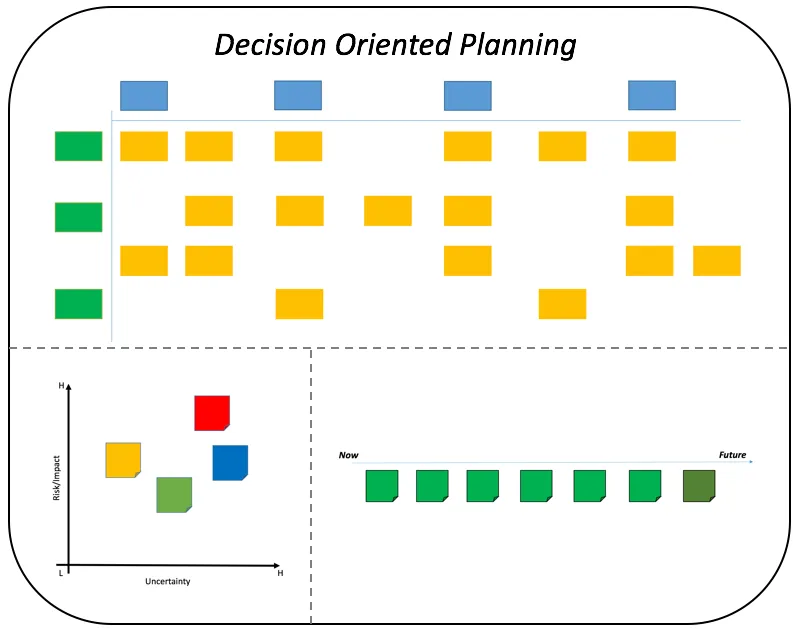
A common challenge while planning is getting the right balance between top-down and bottom-up planning. Purely top-down plans suffer from not being based in reality, while purely bottom-up plans can be so specific you lose flexibility in achieving your outcomes.
The tendency is for teams to get stuck amongst the weeds, overlooking common sense strategies to address risks.
By using a set of lightweight activities, teams can avoid this and start to systematically think about the big picture, align on what is important, and agree on a way forward. During a workshop at Alistair Cockburn's Agile Masterclass in Sydney, Alistair highlighted that the combination of these activities reminded him of John Boyd's OODA (Observe, Orient, Decide, Act) loop — leading me to think of this approach as Decision Oriented Planning.
The OODA Loop
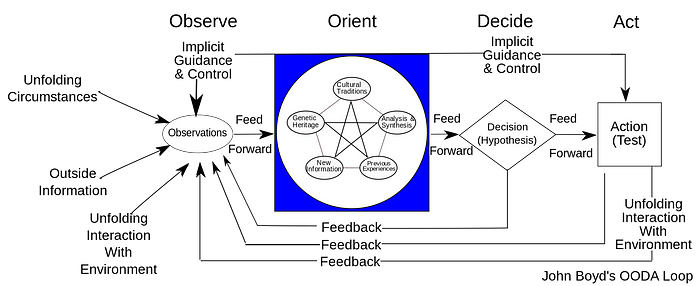
John Boyd's OODA Loop
Informed by his experience at the US Air Force, John Boyd developed the OODA loop and presented it in 1995 in "The Essence of Winning and Losing". The OODA loop values agility over raw power. By being able to execute an OODA loop faster than a competitor, a company can stay ahead of the game, undermining a competitor's ability to respond.
In a team environment, the four elements translate as:
- Observe — Understand the environment
- Orient — Align on what is important
- Decide — Agree on a good course of action
- Act — Do it
Observing the Environment
My preferred approach for observing the environment is Jeff Patton's Story Mapping approach — the de facto standard for visualising product backlogs. It encourages storytelling as a technique to flush out gaps in the environment, and provides a two-dimensional backlog enabling better visualisation of priorities and dependencies.
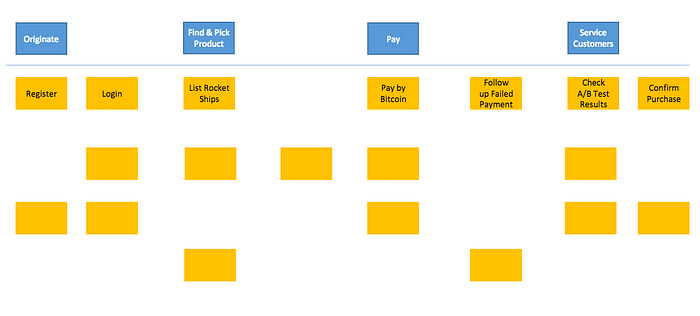
Story Map of user actions and activities
Orienting on What's Important
To orient, I use the Risk Impact Map. Because it is so simple, it is also extremely powerful.
Teams are asked to raise risks in any one of four categories:
- Desirability — Will a customer want it?
- Feasibility — Can we technically build it given our current environment?
- Viability — If we build it, will we be able to make money from it?
- Consumability — Will a customer be able to find it and consume it?
By providing this starting frame, we shift thinking away from mainly feasibility-oriented risks towards a holistic systems view that exposes additional risks that would typically remain hidden.
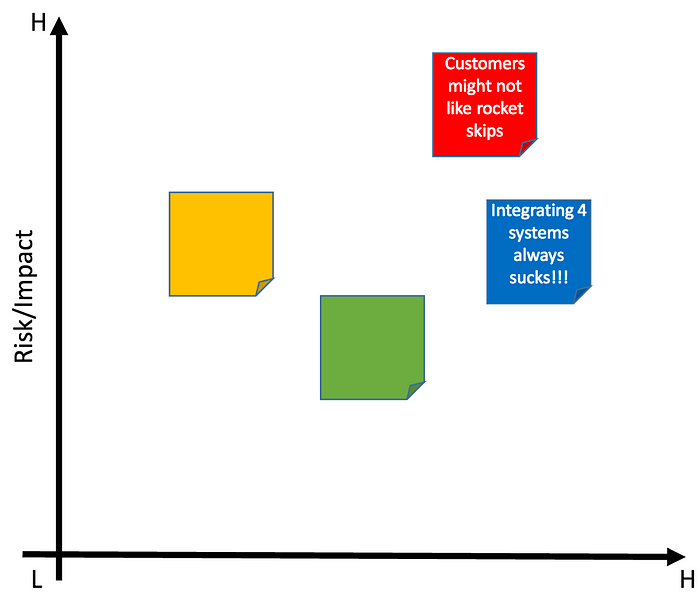
Risk Impact Map
With the map completed, teams are challenged to identify the smallest thing that can be done to de-risk items in the top right quadrant — the most likely and most impactful risks.
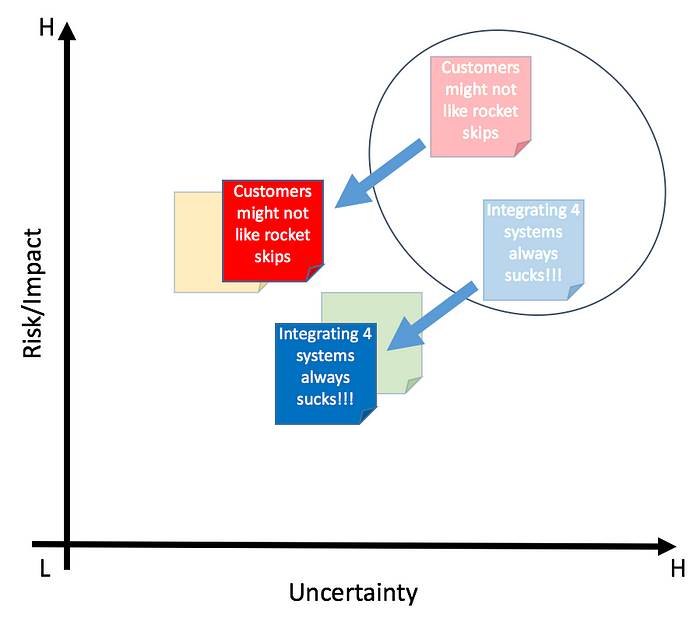
Actively eliminate top right risks
Deciding on a Good Course of Action
After having observed the environment and oriented on what is important, it can still be difficult to decide on a course of action. The technique I've found most effective is Outcome Mapping.
Using an "envision the end state" approach, this technique helps teams decide on an immediate course of action to achieve a longer-term goal. (This approach is also used in other techniques such as The Future, Backwards and the Toyota Kata to help set direction in complex problem domains.)
Outcome Mapping is as simple as drawing a single line starting at now, and ending in the future. Leaders and stakeholders use post-it notes to identify any key milestones that exist. These constraints set an identified end state. Within the defined constraints, teams then identify the outcomes that they would deliver in order to meet the desired end state.

Outcome Mapping
With outcomes defined, it is highly valuable to ask the team to group outcomes into mini milestones — identifying releasable slices and the mid-horizon goals that define what a team is trying to achieve during that period.
Acting on the Outcome Map
Having decided on an agreed outcome map, teams take the output back to the Story Map. The Story Map reflects the chosen course of action. Release slices or outcomes are placed to the left of the story map in order, and the cards are reordered and sliced to define the minimum work required to achieve the desired outcome.

Outcomes (green cards) are used to influence the Story Map
Completing any outcome completes a single OODA loop and provides information that influences future decisions.
Final Note
These activities can easily be completed within a few hours, and set an agreed direction of one or two months.
Accelerating through the OODA loop by regularly reviewing and revising the Risk Impact Map and the Outcome Map will ensure teams adjust their direction based on the changing realities of their environment.
With so many factors affecting delivery, this approach should help your teams apply a basic OODA loop — ensuring that they are always making the best possible decisions available to them.
If you are interested in accessing the Decision Oriented Planning workshop materials please feel free to contact me.