

Organisations typically approach creating team alignment by setting and sharing a company vision. But this often falls flat, failing to resonate with team members on the ground — because the importance of helping individuals understand how they personally contribute to the bigger picture is often overlooked.
When there's a disconnect between the company's vision and team members' personal connection to it, you'll often hear: "I can't do anything about vision, so why is it in my KPIs?"
That's why any approach to organisational alignment needs to leverage a range of different information and mechanisms to help staff discover why, how, and what they can do to help achieve what the company wants.
Why a Company Vision Doesn't Always Help
In today's increasingly volatile workplace, the ability to respond quickly and effectively under uncertain conditions is critical. Start-ups that succeed are generally able to identify and capture value quickly and persistently. But as a company grows, its ability to respond quickly to different market conditions can deteriorate.
By ensuring team members are aligned, pulling in the same direction, and maximising the value they generate, deterioration due to growth can be minimised.
The Missing Ingredients to Alignment
Enter Systems Thinking and Directed Opportunism. Both recognise that, to create purpose-driven teams committed to achieving a specific goal, it's important that individuals generate their own personal meaning from higher-level intent.
By increasing alignment and accelerating feedback loops between team members and leaders, you can increase the rate at which teams respond to changing market conditions. Team members who have a clearer understanding of what they're trying to achieve are more willing to take independent necessary action — and more willing to challenge activities that don't achieve these goals.
The Strategy Brief
Inspired by Stephen Bungay's "The Art of Action" and adapted using concepts from Peter Senge's "The Fifth Discipline", the Strategy Brief uses 5 key factors to create alignment between leadership and team members. It:
- Acts as a focal point, so team members can create and anchor to a shared vision
- Exposes inherent and underlying assumptions, enabling greater levels of engagement and flexibility
- Encourages dialogue around effective strategies and tactics
- Enables accelerated feedback and back-briefs between leadership and teams
- Visualises the strategy and its key factors within a canvas, enabling complex interactions to arise
How to Get Started
1. Create a focal point for complex interactions
Start by using the Strategy Brief canvas to anchor discussions and help your team explore their environment. Teams dealing with complex problems often struggle to agree about what they're trying to achieve — an anchor or focal point concentrates discussions and fosters alignment.
2. Start with the facts to reduce emotions
Once everyone is engaged, emotions can run high. Start by capturing only factual, indisputable information about the environment — free of emotion. This creates a foundation for shared understanding.
Hot tip: While filling in this section, you'll want to think about questions like:
"Where is the company moving to?" "Do we have any current people issues?" "What's the health of the product we work on?"
3. Alignment on context and strategies
Now that you have a factual basis, begin aligning your team around their interpretations of their environment. Strategies should be targeted at broad rules that help your team make the same or similar decisions when encountering different challenges.
Hot tip: While filling in this section, you'll want to think about questions like:
"If people are having issues, what does it mean to how we are supporting our teams?" "If our company is executing a new strategy, what strategies are likely to help my team succeed?"
4. What do we want to achieve?
With the environment elements complete, your team can now frame the rest of the Strategy Brief around what they intend to achieve. They'll need to consider:
- Their value proposition: "What is the value we deliver that no one else can?"
- Their freedoms: "What can we safely change without repercussions?"
- Their boundaries: "What things limit what we can do?"
- Their intent: "What do we want to achieve?"
- Their high-level intent: "What does our boss, and our boss's boss, want to achieve?"
5. Know whether you're making progress
Articulation of Key Results and Metrics is critical to facilitating effective feedback. You need a good blend of holistic metrics to guide overall objectives, as well as operational metrics to assist a shorter feedback loop.
Give It a Go
You may want to consider regular review sessions every 4–6 weeks to ensure your team keeps evaluating their environment. I've found the strategy brief sessions I've run have been extremely insightful — and I hope you will, too.
Strategy Brief Template — A0 Canvas
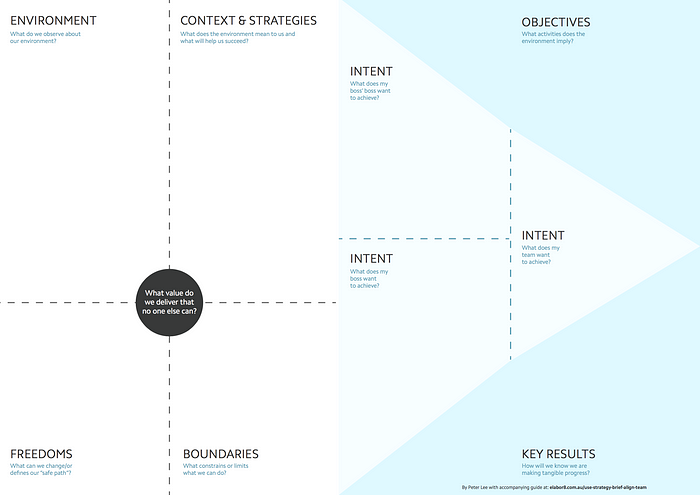
Strategy Brief Template
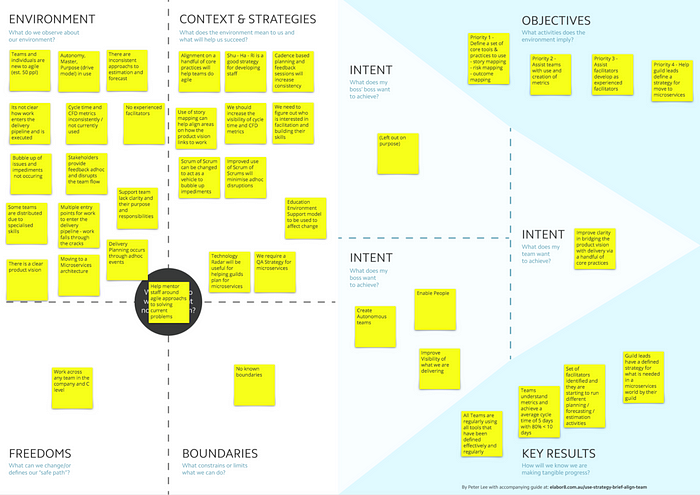
Strategy Brief Example
Originally posted at elabor8.com.au