

Modern companies understand that embracing diversity and inclusion can significantly increase the effectiveness of their team. Diversity in all its forms leads to more innovative products, solutions, ways of working, and ultimately, increased company performance (see McKinsey's paper on why diversity matters).
Being able to create inclusive teams is so important to me that a while ago I wrote a post on why building teams was so important. In it I highlighted that teams benefit from having an explicit focus on building empathy and team cohesion. I outlined a few basic steps on what you should be thinking about, but I didn't delve into what activities or practices you could use to do so.
This post will outline my three go-to activities for helping teams deliberately build empathy for one another — improving their ability to create a more inclusive team.
When attempting to build a team with high levels of cohesion, I typically focus on two key things:
- Building empathy for one another
- Codifying that empathy into an explicit operating agreement of how the team will work with each other
In many teams, empathy building is left to develop through team building events. Quite often after the session, nothing really changes and everything goes back to how it was before.
This post will focus on three activities that can help you build empathy in a systematic way. For most teams, one of these three activities is almost always appropriate:
- Moving Motivators
- Game vs Process
- The Best Team You Ever Worked On
The choice of which activity to use is normally based on the current dynamics of the team members. Moving Motivators is the most structured approach but can feel intrusive and artificial if a team doesn't feel safe in sharing. On the other hand, "The best team you ever worked on" is the least structured approach and although it is less intrusive it may lead to less insightful outcomes.
1. Moving Motivators
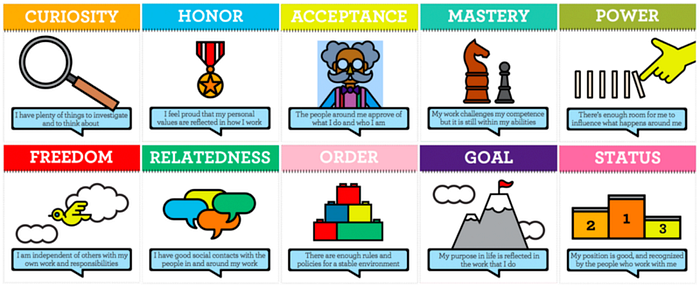
Moving Motivators — 10 Intrinsic Desires
Moving Motivators is a Management 3.0 activity created by Jurgen Appelo. This activity provides a well-structured approach to exposing the inner drivers of your different team members.
Individuals are asked to prioritise a set of 10 intrinsic desires based on what is most important to them. By sharing back and visualising these different desires as a group, teams can begin to understand what is common — or not — about what drives the individuals within the team.
At its best, this approach enables a team to define an operating structure that helps each individual achieve their personal drivers while working as a team. At worst, it provides a platform for teams to empathise with each other and decide on compromises that give the team the best balance in achieving competing drivers.
The other huge benefit of Moving Motivators is in using it to enable team members to express whether they feel that the current environment is achieving their various drivers. Rather than waiting to be surprised when someone quits, you can use these insights to make immediate adjustments to your team.
Because not all teams are co-located, I've also made a Google Drawing version of Moving Motivators for use with distributed teams.
2. Game vs Process

Game vs Process
Game vs Process is an activity Jeff Patton uses during his Passionate Product Owner course. This is a slightly structured approach that is less intrusive than Moving Motivators — making it perfect for teams that don't feel safe enough to share their innermost feelings but would still benefit from a little structure.
This activity starts with a team listing all the terms that come to mind in relation to games, followed by a period of listing all the terms that come to mind in relation to processes.
Team members then express their views about which of the various terms that have been listed come to mind when they think about the best team they've ever worked on.
For most teams, the factors they select will span both games and process — but the exact mix will be different depending on the individuals within that team. Having an appreciation for what factors a team wishes to retain helps them decide on an operating pattern that achieves those characteristics.
3. The Best Team You Ever Worked On

What was the best team you ever worked on?
This approach is the most unstructured of the three — and also the least intrusive.
It's kicked off as a simple, unstructured conversation about what was the best team each individual ever worked on. Each team member is given the opportunity to talk about what team this was and what it was about that team that made it so great. By providing the platform for each person on the team to express the dynamics of the team they enjoyed the most, the team is able to build a great appreciation for how each team member likes to operate.
After sharing their stories, team members are then challenged to define an operating agreement that will ensure the current team will become the best team they have ever worked on.
After having run one of these sessions, it is important to codify the operating agreement into a visible artefact that the team can use to remind themselves of how they have agreed to operate — and to call out when things are happening that are not consistent with their agreed rules.
For the teams I work with, I encourage them to do this via a social contract and to put this somewhere that allows team members to reference it.

Example social contract
Once that operating agreement becomes habit, it is often a great opportunity to run one of these sessions again to create a new agreement around new items that will make the team even better.